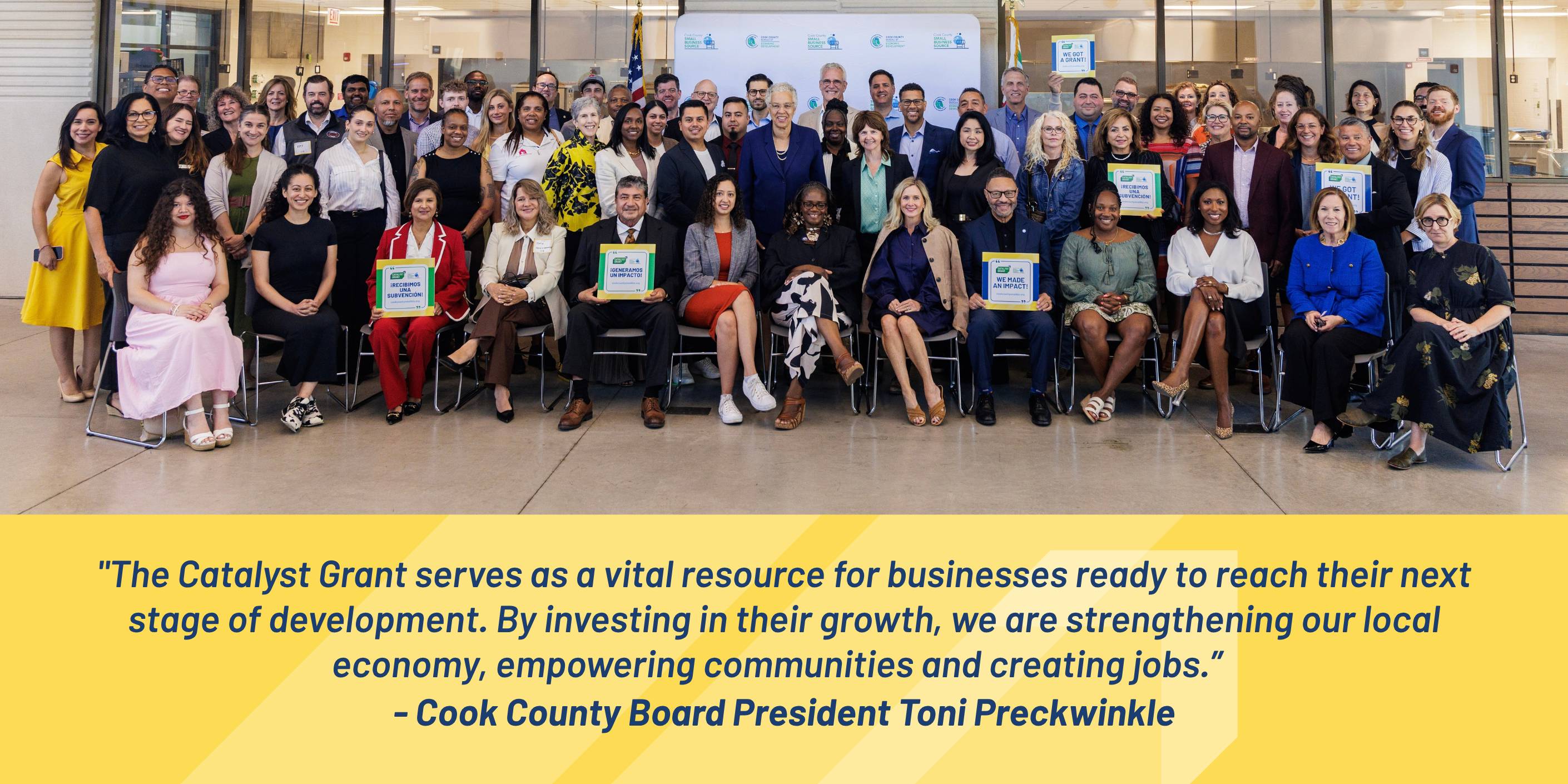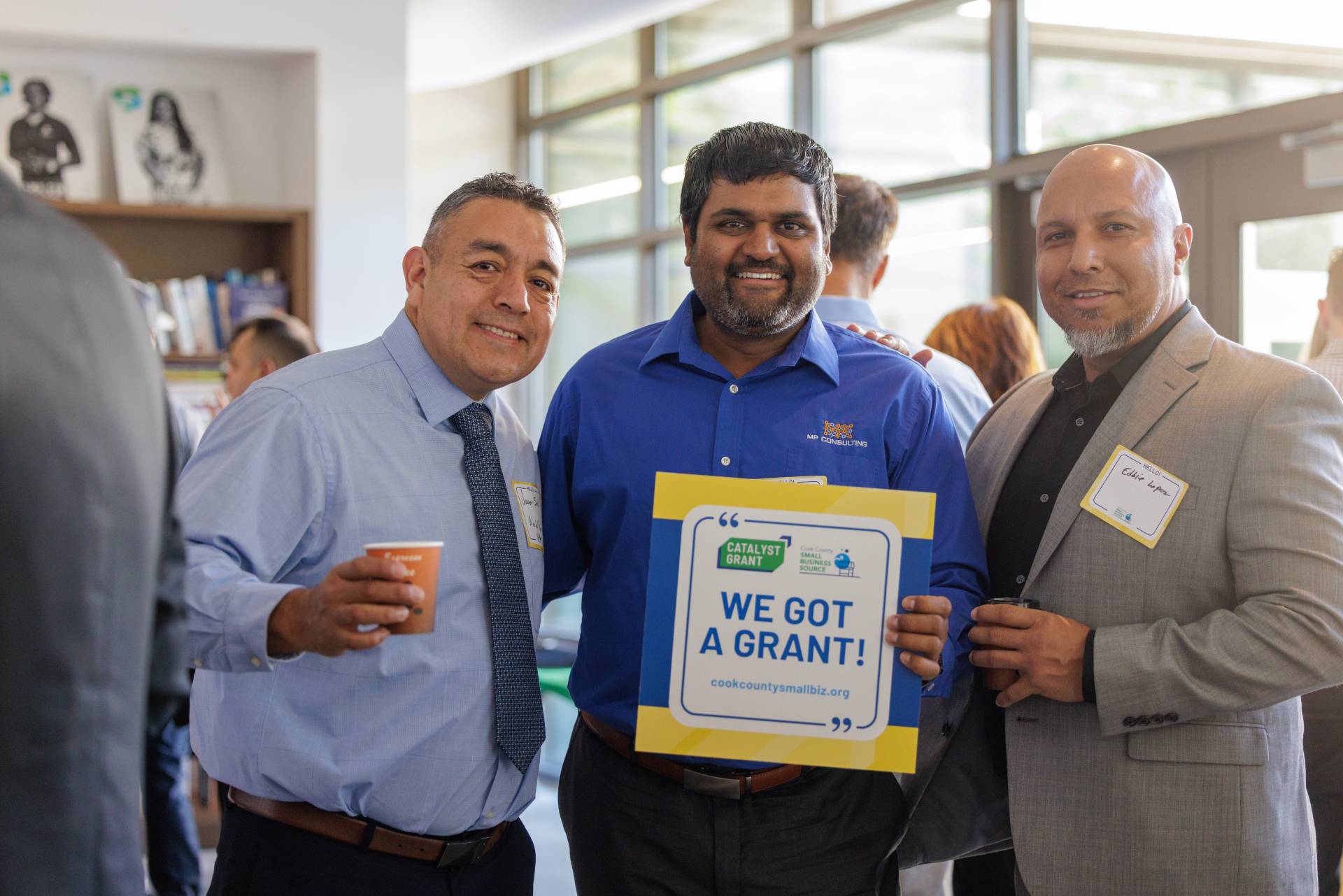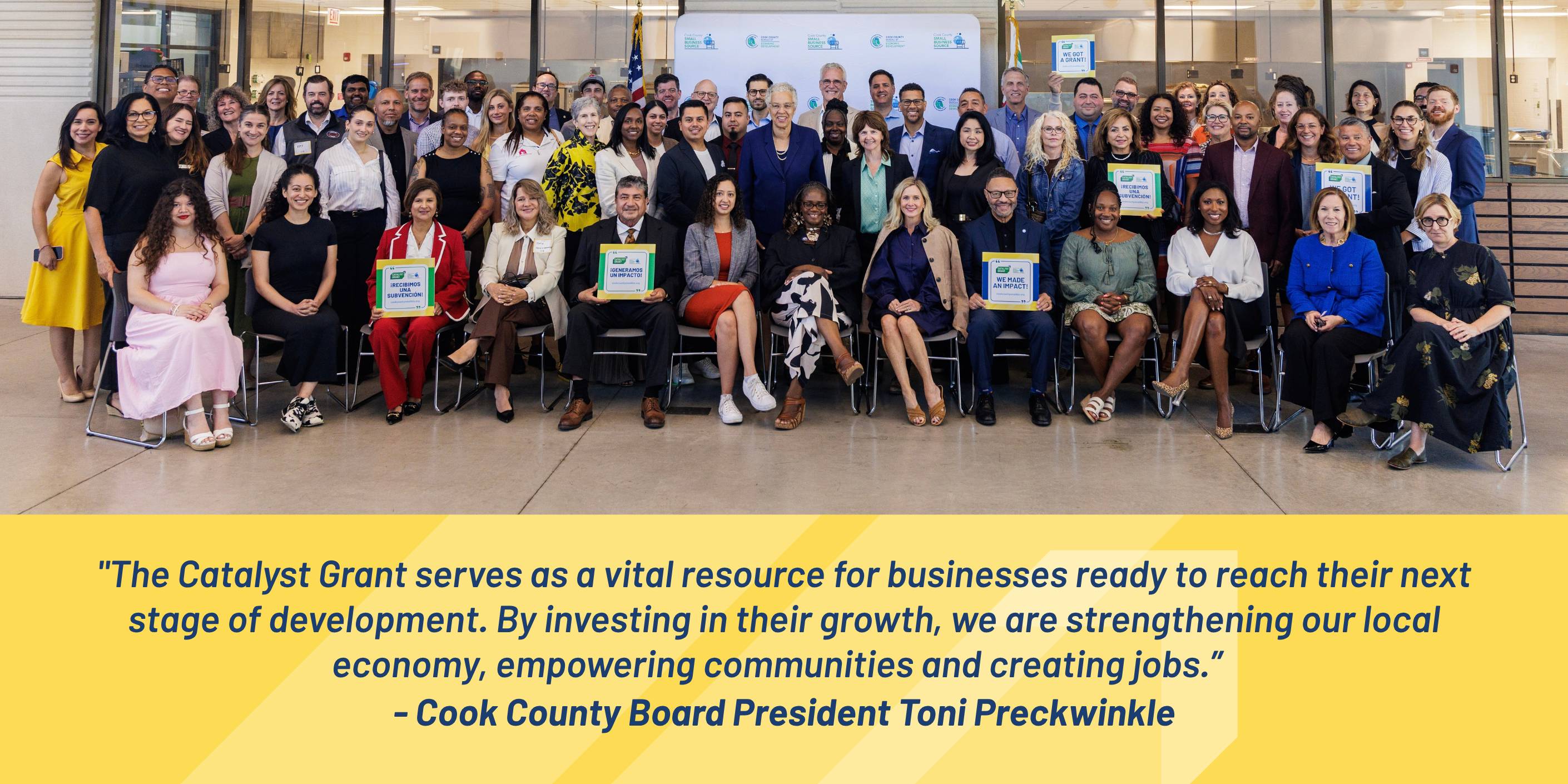
The Cook County Small Business Source is pleased to announce the 92 recipients of a Catalyst Grant. Each business received $100,000 to fuel its next phase of growth.
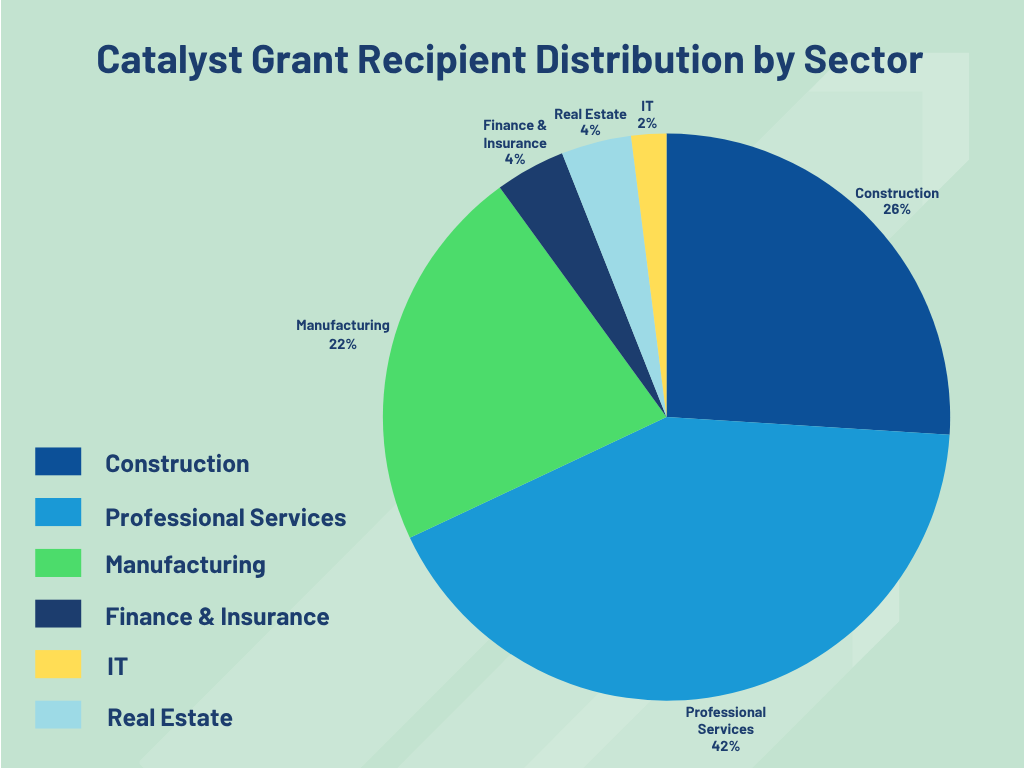
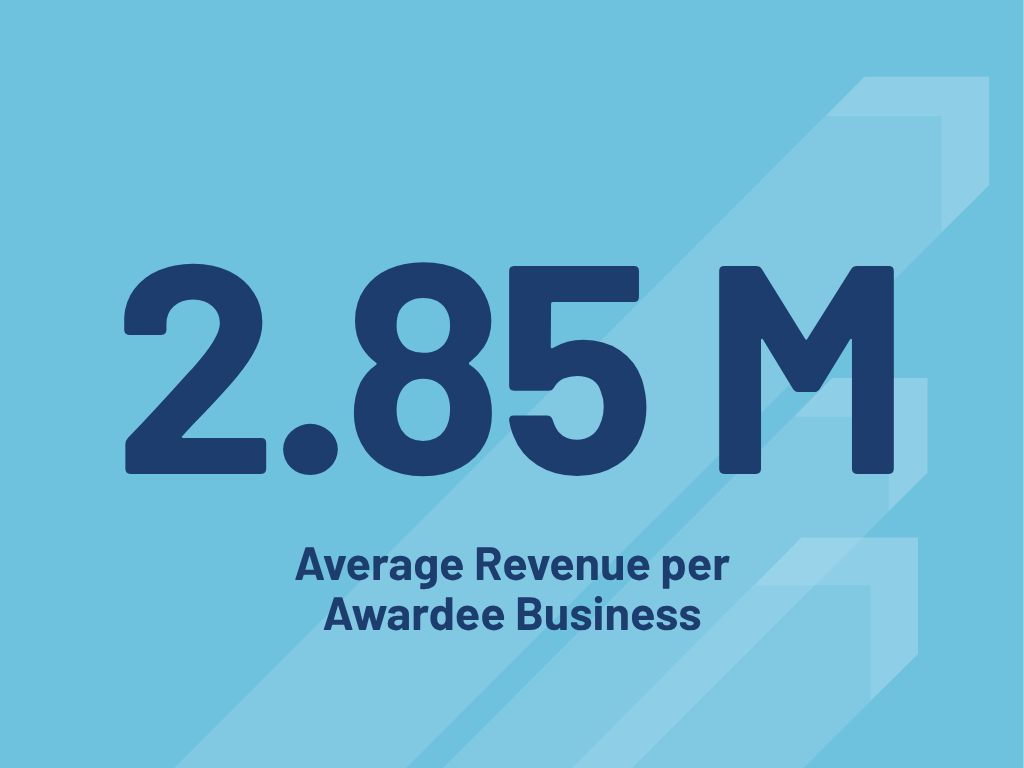
Launched in 2025 by the Cook County Bureau of Economic Development, the Catalyst Grant program supports established businesses across the County. This $9.2 million investment supported firms with a proven track record of growth and annual revenue between $500,000 and $10 million, working in sectors including construction, finance and insurance, information technology, manufacturing, professional services and real estate
Grant funds may be used to hire or train staff, expand or improve facilities, or purchase equipment that supports business growth.
Frequently Asked Questions (FAQs)
Last Updated 9/18/2026
What is the Catalyst Grant?
The Catalyst Grant program, launched in September 2025 as part of the Cook County Small Business Source initiative, provided 92 businesses with $100,000 grants to accelerate their next phase of growth. Funds can be used for hiring/training talent, purchasing equipment or upgrading facilities. While Cook County originally announced that up to 88 business would be selected, the County had funds to support 92.
Who funds and manages the program?
The Cook County Bureau of Economic Development utilized $9.2 million of American Rescue Plan Act (ARPA) funds to support the grants associated with this program. Cook County has contracted with the Women’s Business Development Center (WBDC) and Allies for Community Business to serve (A4CB) as the program administrators.
When was the application period?
The application portal opened September 25, 2025 and closed November 14, 2025 at 5:00pm CST.
Will all applicants receive grant dollars?
No. We anticipate that demand will exceed the available funding. In total up to 92 grants of $100,000 each will be awarded.
How can grant funds be used?
Funds must be invested in equipment, people, and/or facilities directly related to business growth. The full list of eligible uses is provided below:
EQUIPMENT
- Office & Administrative Equipment
- Computers, laptops, and servers
- Printers, scanners, and copiers
- Telecommunications equipment (phones, VoIP systems)
- Furniture (desks, chairs, filing cabinets)
- Production and Construction Equipment
- Machinery and tools (for manufacturing, assembly, or fabrication)
- Vehicles (delivery trucks, forklifts, company cars)
- Heavy equipment (excavators, cranes, bulldozers)
- Raw material handling equipment (conveyors, loaders)
- Storage and warehousing equipment (shelves, racks)
- IT & Technology Infrastructure
- Software and licensing (ERP, CRM, productivity tools)
- Networking hardware (routers, modems, servers)
- Data security systems (firewalls, cybersecurity tools)
- Cloud computing and storage solutions
- Customer Service Equipment
- Point-of-sale (POS) systems
- Display fixtures and merchandising units
- Self-service kiosks
- Inventory management tools (RFID scanners, barcode readers)
FACILITIES
- Building Acquisition & Leasehold Improvements
- New building construction
- Leasehold improvements
- Other site improvements, including landscaping
- Renovation & Expansion
- Major remodels and upgrades
- Expansion of existing facilities
- Structural modifications for operational improvements
- Site improvements such as landscaping
- Energy Efficiency & Sustainability Improvements
- Lighting Systems
- Building Controls
- Building Envelope Improvements
- Furnaces, Boilers & Chillers
- Heat Pumps
- Pumps, Motors & Variable Speed Drives
- Low flow fixtures
- Heat Recovery
- Fuel Switching
- Renewable Energy Investments
- Solar PV
- Battery Storage
- Biofuel
- Geothermal
- Wind
- Electric Vehicle Charging Infrastructure
- Level 2 Charging Stations
- DC Fast Chargers
- Water Use Improvements
- Water recycling systems
- Stormwater management
- Bioretention, green roofs, cisterns & porous pavement
- Lead pipe abatement
- Resiliency Improvements
- Flood Mitigation
- Wind resistance
- Micro-grids energy storage & backup systems
PEOPLE
- Hiring & Recruitment
- Salaries, wages and benefits (new hires, existing employees)
- Recruitment costs (job postings, talent acquisition software)
- Signing bonuses and relocation assistance
Can grant funds be used to reimburse expenses already incurred?
No. Grant funds may only be used for expenses incurred after the grant has been disbursed.
Can grant funds be used to improve my facility if I don’t own the building?
Yes. Before receiving the grant, you will be asked to provide two documents:
A copy of your lease with an expiration date of no earlier than one year from the date of your grant application
- A signed letter from the owner of your building in which the owner acknowledges that you will be using County funds to improve the facility
When do grant funds need to be used by?
Are grants taxable?
Yes. Recipients of a grant award will receive tax information related to their grant proceeds, which will need to be reported on their tax returns. Please consult with a tax professional for additional information.
What reporting to Cook County will be required after receipt of grant funds?
Recipients must:
- Sign a grant agreement with Cook County to receive grant funds
- Participate in impact evaluation surveys
- Provide documentation to substantiate the use of the grant funds
- Submit 2025 and 2026 tax returns
I did not receive a grant; can I find out why?
The Cook County Small Business Source (The Source) only has funding to support 88
Catalyst Grant applications but received over 1,200 applications. Due to the volume of applications received, we are unable to provide feedback to individual applicants as to why their application was not selected for funding.
Grant administrators found applications ineligible for a variety of reasons; failure to meet any of the grant requirements led administrators to eliminate the application from further consideration, including:
- The applicant listed an ineligible NAICS code.
- The applicant reported 2023 and 2024 revenues of less than $500,000 (which is below the
minimum revenue needed for eligibility). - The applicant failed to include all required tax forms (including but not limited to
2023 tax return, 2024 tax returns or the proof of the filing of an extension to file 2024
returns). - The applicant failed to demonstrate growth in both net income and employee count
from 2023 to 2024. - Any other incomplete information within the application or attachments.
We encourage all applicants to explore financing opportunities featured on Capital Resources | Cook County Small Business Source.
How were grant award recipients selected?
Following the application deadline, grant administrators reviewed applications for eligibility based on program requirements and then assigned a randomized identification number to each qualifying application. Eligible applications were selected for funding by randomized identification number until award funds were fully committed. We received more eligible applications than we had funds to support.
Will there be another grant program?
Due to County budget constraints and the conclusion of ARPA funding that previously supported this program, we do not anticipate grant programs in 2026 or 2027. For information on capital resources, please visit our Capital Resources page.
How were Catalyst Grant award recipients selected?
Following the application deadline, grant administrators reviewed applications for eligibility based on program requirements and then assigned a randomized identification number to each qualifying application. Eligible applications were selected for funding by
randomized identification number until award funds were fully committed. The Cook County Small Business Source (The Source) received more eligible applications than we had funds to support.
I received an award notification, what’s next?
You are now part of a select group of 92 businesses in key growth sectors receiving support through this program. The Source will use the email address catalyst.bed@cookcountyil.gov for all grant program related communications. Please add this email to your safe senders list. Below are the next steps:
- You will receive your grant agreement for signature via Docusign by Friday, June 19, 2026. Please review it carefully and sign it by July 1, 2026. Once The Source team receives notification of your signed agreement, we will sign the agreement and you will receive a signed version for your records.
- We’d also like to learn more about your business so we can better support your goals. You’ll receive an intake form by email; please also complete it by July 1.
- The Source’s grant administrator, the Women’s Business Development Center (WBDC), will process your award payment. After The Source receives your signed agreement and completed intake form, we will instruct WBDC to issue your payment. To process your payment, WBDC will invite you to join Bill.com and request your bank information and W-9 to finalize disbursement.
When will I receive the award?
The Source, via its grant administrator, the Women’s Business Development Center (WBDC), will distribute grant awards by the end of September 2026.
How will I receive my award?
Once we have received the executed grant agreement and completed intake form, WBDC, the program’s grant administrator, will send an invitation to join Bill.com. Once enrolled, you can choose whether to receive your funds via direct deposit or by paper check, based on the information you provide through Bill.com.
Are grant proceeds taxed?
Please consult with a tax professional. Recipients of a grant award will receive a Form 1099 related to their grant proceeds from our grant administrators, WBDC, which will need to be reported on their tax returns.
What should I do if I have additional questions?
Please feel free to contact catalyst.bed@cookcountyil.gov with questions.
I have not heard anything about my grant application status; whom do I contact?
On May 22, all applicants were sent notification of their application status to the email address contained in their application from info@cookcountysmallbiz.org. If you have not received an email, please check your “spam,” “junk” or “other” folders. In the event you do not see a status update, please contact catalyst.bed@cookcountyil.gov
Which sectors were eligible?
This program targeted key economic sectors that had demonstrated growth and profitability. Eligible businesses were required to fall into one of the following sectors: construction, finance and insurance, information technology/technology, manufacturing, professional services, and real estate. A list of NAICS codes associated with these sectors is included in the “Industry Definitions” section below.
Which businesses could apply?
Businesses were required to meet all of the following criteria:
- Be a for-profit business
- Be located in the city of Chicago or suburban Cook County, IL
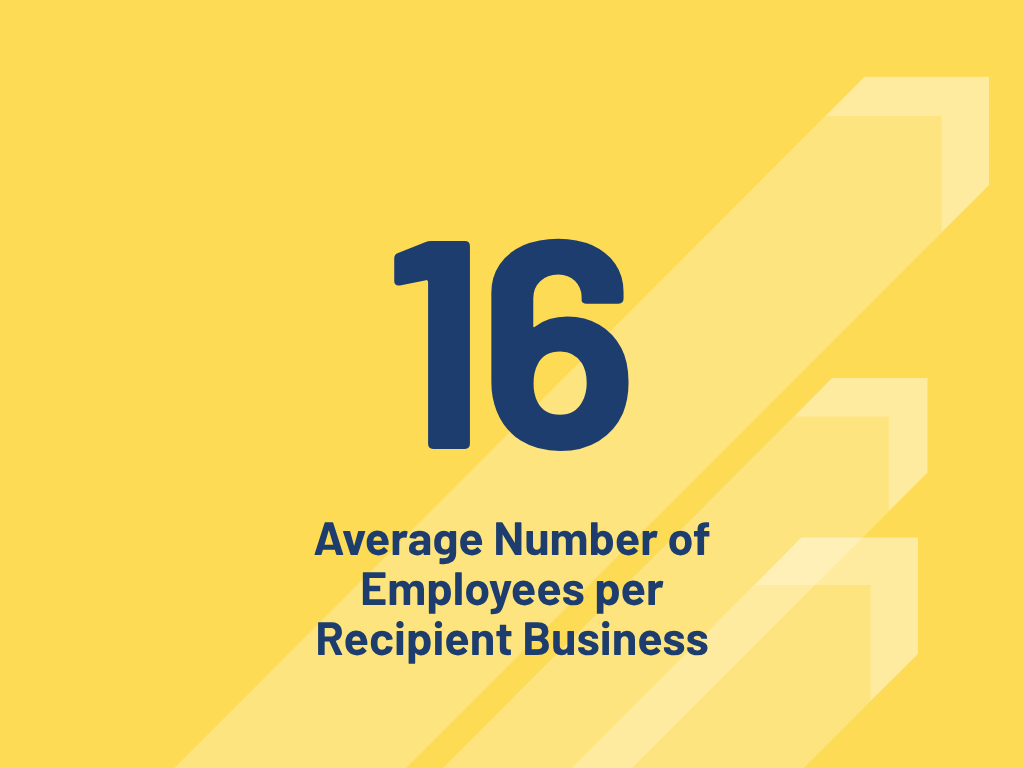
- Have at least one full-time employee in addition to the business owner in 2024 and at the time of application
- Have annual revenue between $500K and $10M in both 2023 and 2024
- Operate in one of the following industries, as outlined under “Industry Definitions”: construction, finance and insurance, information technology/technology, manufacturing, professional services, or real estate
- Demonstrate business growth (see next question)
What counted as “evidence of business growth”?
Businesses were required to demonstrate growth in both net income and employee count from 2023 to 2024. Net income was verified using filed 2023 and 2024 federal tax returns, and employee count was verified using Form 941 for Q4 2023 and Q4 2024.
Were there any restrictions based on business owner demographics?
No. Business owners of all demographics were eligible to apply.
Was there a required business start date to be eligible?
No. Businesses that opened at any time were eligible for the grant.
Who was not eligible?
Nonprofits, non-employer businesses and the following restricted entities were not eligible:
- Businesses engaged in activities prohibited by federal law or applicable local law
- Businesses principally engaged in teaching, instructing, counseling, or indoctrinating religion or religious beliefs (in any setting)
- Government-owned business entities
- Businesses primarily engaged in political or lobbying activities
- Cannabis businesses
- Nightclubs or strip clubs
- Gambling businesses, including sports betting venues and game shops
- Employment agencies
Were for-profits owned by nonprofits eligible?
Yes, if the for-profit met all other eligibility requirements.
How were eligible industries defined?
Only businesses that fell within the specified NAICS codes were eligible. A full list is available here.
How was “Construction” defined?
Businesses that operated in NAICS codes starting with 23.
How was “Finance and Insurance” defined?
Businesses that operated in the following NAICS codes:
- 5221: Depository Credit Intermediation
- 524: Insurance Carriers & Related Activities
How was “Information Technology/Technology” defined?
Businesses that operated in NAICS codes starting with 51.
How was “Manufacturing” defined?
Businesses that operated in NAICS codes starting with 31, 32, and 33.
How was “Professional Services” defined?
Businesses that operated in NAICS codes starting with 54.
How was “Real Estate” defined?
Businesses that operated in NAICS codes starting with 53.
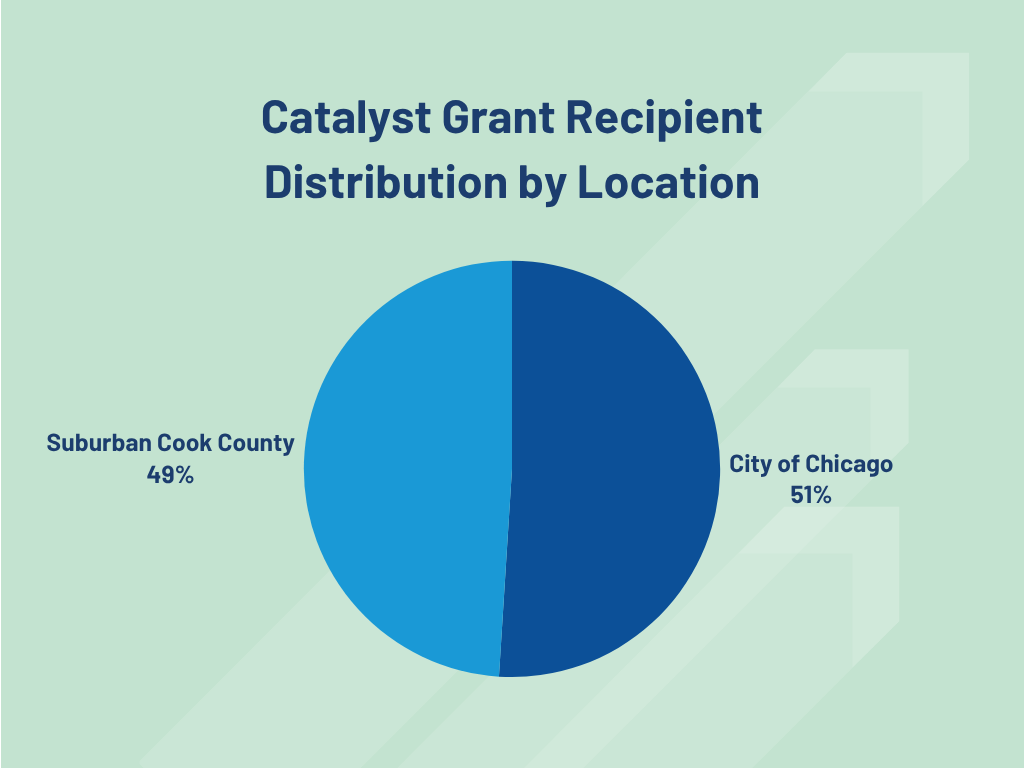
How were grants be distributed between businesses in the city of Chicago and suburban Cook County?
There was no geographic preference between the city of Chicago and suburban Cook County. All eligible businesses were encouraged to apply.
Did the County have any geographic priorities that impacted the distribution of the grants?
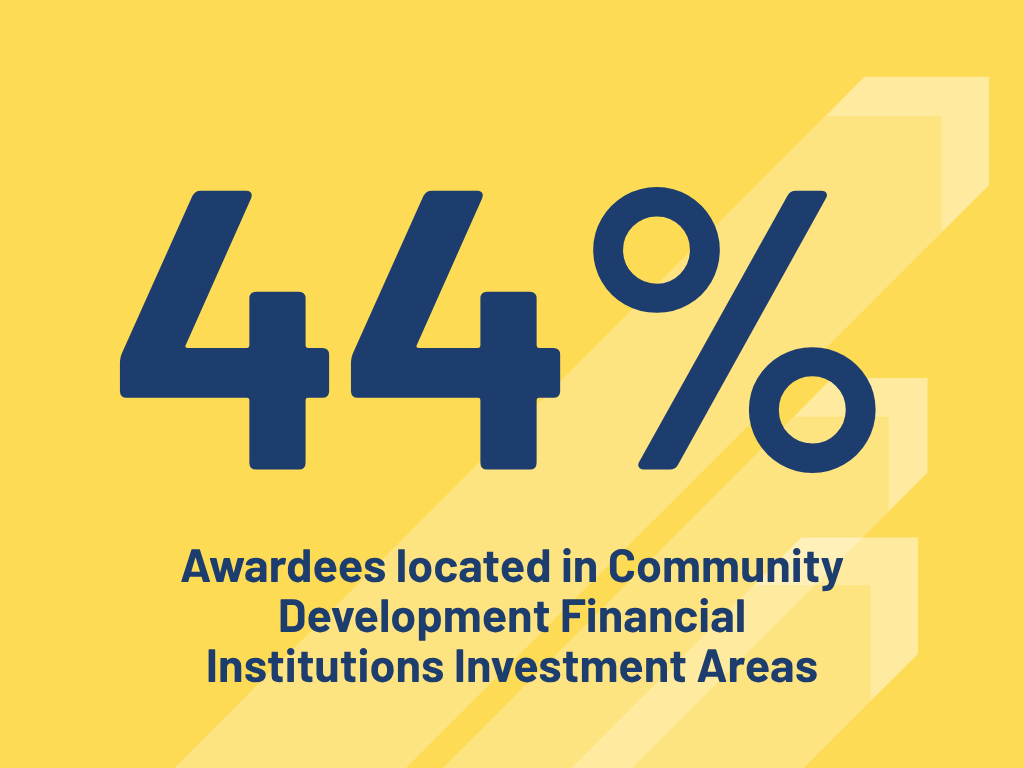
Yes. Cook County aimed to distribute approximately 75% of the grants to businesses located in what is called a Community Development Financial Institution (CDFI) Investment Area. A CDFI Investment Area, as defined by the U.S. Treasury, is a geographic area that meets specific criteria related to poverty, income, and unemployment.
Grant administrators determined whether a business was located in a CDFI Investment Area based on the address provided in its application.
How could businesses determine whether they were located in a CDFI Investment Area?
The US Department of the Treasury provided a CDFI Fund Mapping Tool that businesses could use to determine whether they were located in such an area.